
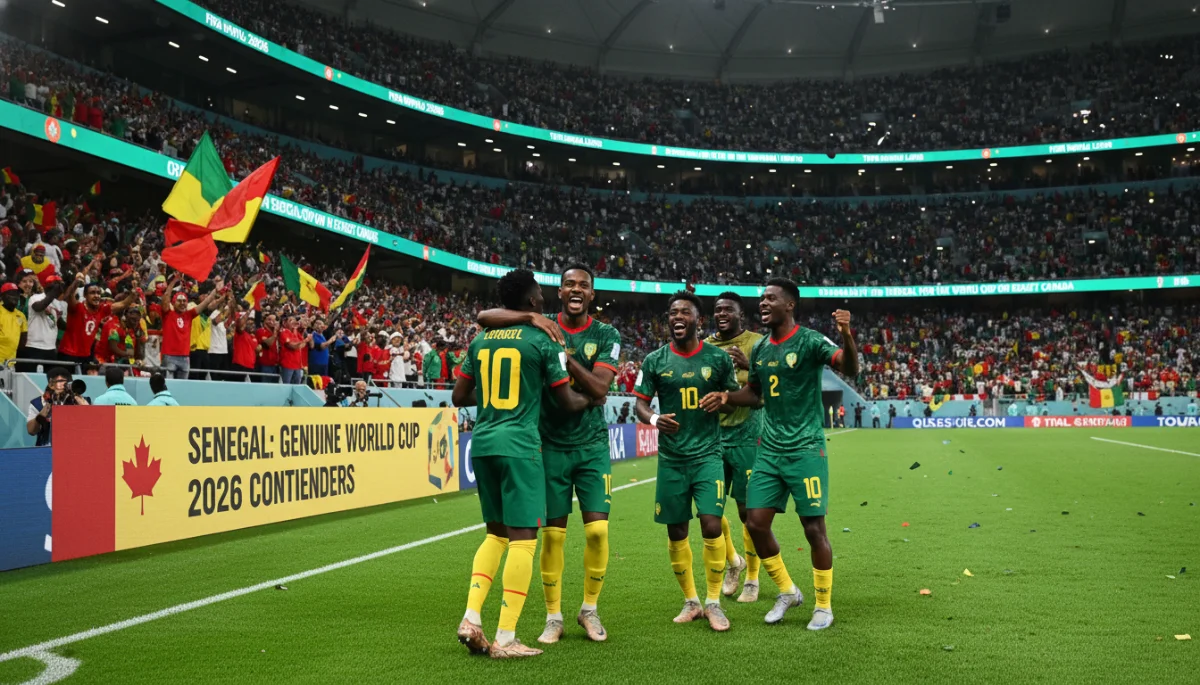
Senegal enters the 2026 World Cup with real ambition, not just hope. Under Pape Thiaw, the Lions of Teranga are being discussed as a team capable of pushing deep into the tournament, yet that rise has come with serious strain on the country’s football ecosystem.
Thiaw’s confidence has become part of the story because it reflects a broader shift in African football: elite national teams no longer see themselves as outsiders. For followers tracking the Senegal World Cup 2026 prospects, the appeal is obvious. The squad mixes proven stars, emerging talent, and enough physical quality to trouble almost anyone, while bettors in Canada can back Senegal for the World Cup on Rexbet Canada if they believe this run has real upside.

Still, the same system that keeps producing top-level players has also created an uneven economic reality. Senegal has become a factory for elite footballers, but the value generated by that success often leaves the country quickly, while domestic clubs and facilities struggle to keep pace.
How Senegal Keeps Producing Elite Players
Senegal’s talent pipeline is unusually strong for a country of about 20 million people. A small group of high-quality academies has built a reputation for turning teenagers into professionals ready for Europe’s biggest stages.
- Generation Foot, Diambars, and Dakar Sacre Coeur are among the best-known development centers.
- These academies offer coaching, schooling, and medical support at a level many domestic clubs cannot match.
- They also serve as direct gateways to Europe, especially to clubs in top leagues.
- Players such as Sadio Mane, Ismaila Sarr, and Pape Matar Sarr have come through this pathway.
The structure looks successful from the outside, but the financial return at home is often limited. Many academies work through long-running deals with European clubs, which means foreign partners get early access to the best prospects and a large share of the eventual upside.
One clear example is the relationship between Generation Foot and FC Metz. Metz has supported the academy for more than 20 years, and in return it has had first refusal on its top talent. That arrangement has helped move careers forward, but it also shows how much control can shift away from Senegal.
The Money Leaves Before the Value Settles
The imbalance becomes sharper when transfer data is examined. Thirteen academy-developed players selected for Senegal’s continental squads produced only about €100,000 in initial fees for their local academies, yet the European clubs that signed them later sold them for a combined €81.2 million. Across those players’ careers, total transfer value has exceeded €411 million.
That gap explains why Senegal’s football success can look like a national triumph while functioning like an export economy. The country develops the talent, but others often capture the largest financial reward.
- Local clubs are frequently left with limited resources.
- Stadiums and infrastructure still need major upgrades.
- The domestic league struggles for visibility compared with European football.
- Even compensation that should return to local teams can be delayed or contested.
Administrative problems make the issue worse. In some cases, clubs have had to push the federation to recover FIFA-mandated solidarity payments tied to major transfers, including Nicolas Jackson’s move to Chelsea.
Why the Diaspora Strategy Matters
Senegal has not relied only on domestic development. The federation has also become highly effective at recruiting players with Senegalese roots who were raised in Europe. That approach has helped close gaps that once favored stronger footballing nations.
Instead of losing top dual-national prospects, Senegal now moves early. The federation often targets players between 16 and 19 before they fully commit to another country, then leans on family identity, cultural connection, and the promise of a competitive national project.
Recent examples include Ibrahim Mbaye of PSG and Mamadou Sarr of Chelsea, both of whom had previously represented France at youth level. Their decisions show how carefully Senegal now works the international market for talent.
A squad built for flexibility
This blend of local graduates and diaspora recruits gives Senegal unusual depth. A veteran such as Idrissa Gana Gueye can line up alongside teenage prospects, which creates a squad with both experience and long-term potential.
What 2026 Could Mean
For Senegal’s best-known names, 2026 may be the final major stage of their international careers. Sadio Mane, Kalidou Koulibaly, and Edouard Mendy represent a generation that has already lifted Senegal’s profile, and North America could be their last chance to define that legacy at a World Cup.
The group draw is far from forgiving. Senegal must deal with France, Norway, and Iraq in Group I, and the opener against France in New Jersey will instantly show how far this team can go.
If Senegal survives the first round, its strengths are easy to identify: discipline, intensity, athletic power, and enough depth to make life difficult in knockout play. The challenge is that the sporting promise is no longer the whole story. The nation is chasing glory while still confronting a system that does not always reward the people who built the foundation.