
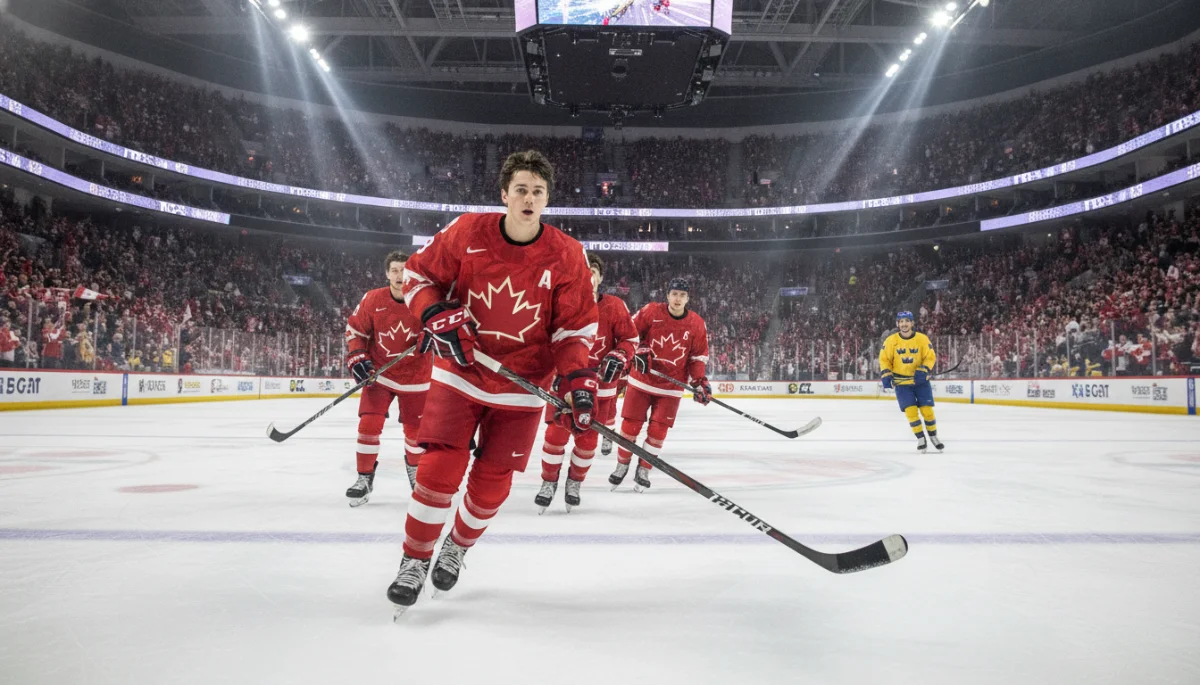
Team Canada has already locked up a semifinal berth at the 2026 Hlinka Gretzky Cup, and the mission now shifts from qualifying to finishing the job. With two dominant preliminary-round wins in Edmonton, Canada has positioned itself for a serious medal push, beginning with Wednesday’s closing Group A game against Sweden.
The final matchup of the opening stage is scheduled for Wednesday, August 5, at Rogers Place, with puck drop set for 5 p.m. Mountain Time and 7 p.m. Eastern Time. Canada has already collected enough points to finish first in Group A, but the meeting with Sweden still matters as a final tune-up before knockout hockey begins.
A Fast, Physical Opening Statement
Canada has looked sharp from the opening faceoff of the tournament. The team opened with a 7-3 win over Switzerland, and the scoreline reflected the pace and pressure Canada maintained throughout the game. A five-goal first period gave the Canadians instant control, and they never allowed the margin to become uncomfortable.
That first game also showed how many different players can contribute. Liam Pue scored twice, Brock England added two of his own, and Camryn Warren, Ryerson Edgar and Benjamin Veitch each found the net. England’s second goal, a short-handed marker in the third period, was a reminder that Canada can threaten in every game state, not just at even strength.
Canada followed that performance with an even more one-sided 6-1 victory over Slovakia. The Canadians again drove play from the start, outshooting Slovakia 48-13 and spending long stretches in the attacking zone. Kayden Stroeder scored twice, while Landon DuPont, Warren, Edgar and Pue also scored. In goal, Leif Oaten handled nearly everything he saw, stopping 12 of 13 shots.
Through two games, the roster has already offered a clear look at its depth and balance.
- Pue, Edgar and Warren each entered the final preliminary game with four points.
- Pue led the Canadians with three goals.
- Maddox Schultz had already collected four assists.
- Canada had produced offense from multiple lines and defensive pairings.
That spread-out scoring is important because it forces opponents to defend the full ice sheet. It also gives Canada more ways to adjust if one line goes quiet in a tighter playoff game.
Sweden Brings Real Stakes Into the Final Group Game
Unlike Canada, Sweden still has something immediate to play for. The Swedes beat Slovakia 4-3 in their opening game before dropping a wild 7-6 decision to Switzerland, which left their semifinal chances dependent on the result against Canada.
That makes Wednesday’s meeting a useful stress test for both teams. Canada can treat it as a chance to keep its rhythm and stay sharp, while Sweden needs a strong response to protect its path into the final four.
There is also recent history between the two sides. Canada defeated Sweden 3-1 in pre-tournament play, but a group-stage matchup carries far more weight than an exhibition result. The stakes, pace and physical intensity should all be higher now that the games count.
Sweden has shown enough offensive talent to stay dangerous. Dorian Eklund Aspe came into the game with four points, while Oliver Sundberg and Milan Sundstrom had each scored twice through two tournament appearances. That kind of production means Canada cannot afford to coast, even with first place already secured.
For head coach Ryan Oulahen, the game offers more than a standings check. It is a chance to manage ice time, test combinations and make sure his group is ready for the faster rhythm that usually defines medal-round hockey. Oulahen also brings useful experience, having worked on Canada’s staff when the country won the tournament in Edmonton in 2024 before taking over as head coach for this edition.
Canada’s focus, then, is less about survival and more about preparation. The group has already done the hard work of advancing; now it has to make sure its best hockey is still ahead.
The Knockout Round Will Reset the Pressure
Finishing first in Group A sends Canada into Friday’s semifinal against the second-place team from Group B. The exact opponent will not be known until the rest of the preliminary schedule is complete, but the seeding path is already set: Group A’s top team faces Group B’s runner-up, while the Group B winner draws the Group A second-place finisher.
That uncertainty is part of the tournament’s design. Canada can control only its own side of the bracket, not the identity of the opponent waiting on the other side. The defending expectation, however, remains straightforward: reach Saturday’s gold-medal game and keep the championship within reach.
The current Group B picture still had several moving parts after two games. The United States sat in first place, while Czechia and Finland were level on three points and Germany was still searching for its first point. That means Canada’s semifinal opponent will depend on how the remaining games unfold.
The memory of last year’s event should serve as a warning. Canada went undefeated in the preliminary round of the 2025 tournament before falling 4-3 to the United States in a semifinal shootout. The team then recovered to beat Finland for bronze, but the loss ended its title run. Strong group play is useful, but it does not protect anyone once elimination hockey begins.
- Friday, August 7: semifinals
- Saturday, August 8: bronze-medal and gold-medal games
- Gold-medal game start time: 5 p.m. Mountain Time
- Broadcast coverage: TSN and RDS
Why This Group Feels Built for a Medal Run
Canada’s opening games have done more than create a favorable standings position. They have also revealed the kind of roster construction that often separates medal teams from those that peak too early. The lineup has scoring depth, mobility from the back end and a goaltender who has already handled a low-shot workload without losing focus.
That combination matters because tournament hockey rarely follows a straight line. One night can be a track meet; the next can become a tight, low-scoring grind. Teams that can win in both settings tend to survive the semifinal and final rounds.
There is also the added advantage of playing at home in Alberta. Canada has historically embraced that setting well, and the crowd energy at Rogers Place should only rise as the medal round approaches. Home ice does not guarantee anything, but it can sharpen momentum when a young team is trying to hold its edge under pressure.
The Hlinka Gretzky Cup is also one of the first major international stages for many players in their draft-eligible cycle. For fans, that means the next few days are not only about medals. They are also about first impressions, breakout performances and the emergence of players who may soon become major names in junior hockey and beyond.
DuPont has attracted attention for obvious reasons, but Canada’s early success has also elevated Pue, Edgar, Warren, Schultz and Stroeder into the conversation. A strong semifinal would give that group its first real elimination-game experience at this level, which is often where reputations begin to harden.
Canada has already taken care of the part of the tournament that required control and consistency. What remains is the harder challenge: converting a dominant start into the kind of finish that ends with gold on home ice.