
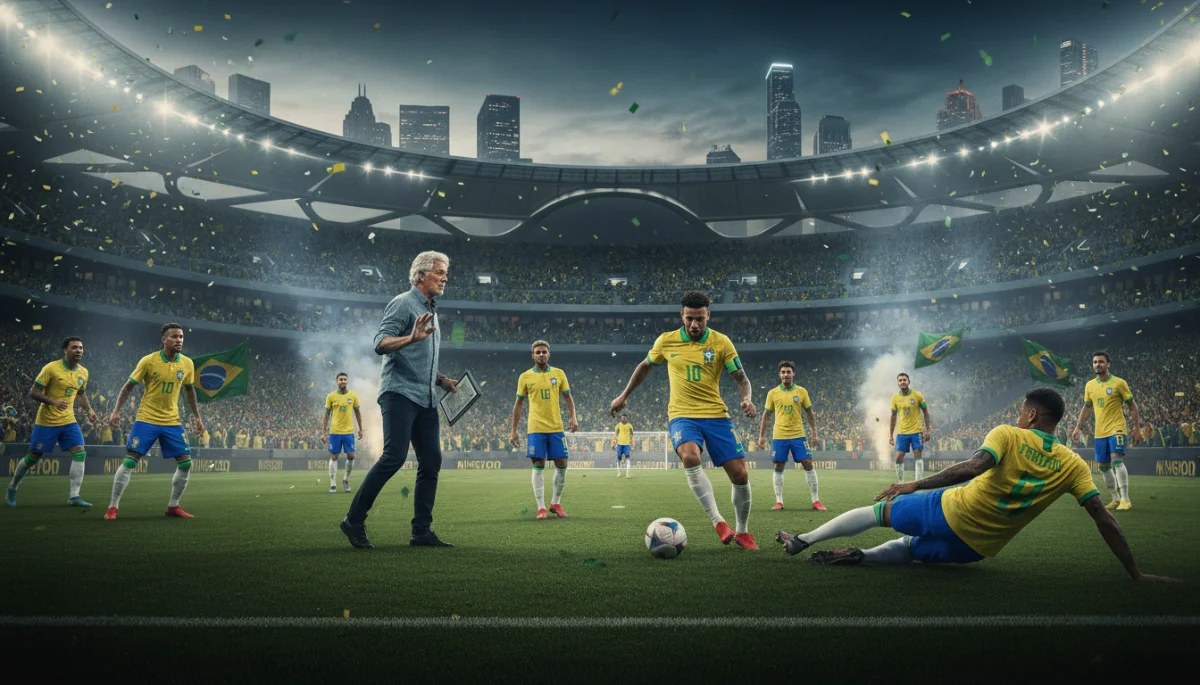
Brazil enters the 2026 World Cup with a familiar burden and a fresh face on the touchline. Carlo Ancelotti is set to finalize his 26-man roster in Rio de Janeiro, closing the door on the initial 55-player pool and sharpening the focus on the group that will try to bring home a sixth global crown across the United States, Canada, and Mexico.
A new era with immediate pressure
This will be Ancelotti’s first major tournament in charge of Brazil, and the stakes could hardly be higher. The five-time champions have not won the World Cup since 2002, and repeated quarterfinal exits have only intensified scrutiny. As a result, this squad is expected to blend reliability, elite European quality, and a few bold decisions that reflect current form rather than reputation alone.
Why this selection matters
The coach is not just picking names; he is defining the identity of a team that must perform under immense expectation. That means balancing defensive security, midfield control, and enough attacking firepower to punish opponents in knockout matches.
The core group that looks safe
Several players are widely viewed as near-certainties, and the spine of the team appears relatively settled. Based on reporting from major Brazilian and international outlets, the most secure options include:
- Goalkeepers: Alisson as the starter, with Ederson behind him
- Center backs: Marquinhos and Gabriel Magalhaes as the main pairing
- Midfield engine: Casemiro, Bruno Guimaraes, and Lucas Paqueta
- Front-line threats: Vinicius Junior, Raphinha, Matheus Cunha, and Gabriel Martinelli
At fullback, Wesley is the leading candidate on the right, especially with Vanderson unavailable. Alex Sandro is also expected to provide stability on the left.
| Area | Likely main option | Reason it matters |
|---|---|---|
| Goalkeeper | Alisson | Trusted shot-stopper and clear No. 1 |
| Center defense | Marquinhos, Gabriel Magalhaes | Leadership, pace, and aerial strength |
| Midfield | Casemiro, Bruno Guimaraes, Lucas Paqueta | Balance between protection and creativity |
| Attack | Vinicius Junior, Raphinha, Matheus Cunha | Direct pace and decisive final-third quality |
Injuries that changed the picture
Brazil’s plans have been complicated by several major absences. Three prominent players are expected to miss the tournament because of injury, and each loss affects the squad in a different way.
- Rodrygo of Real Madrid, sidelined after knee ligament surgery
- Estevao Willian of Chelsea, ruled out by a serious muscle injury
- Eder Militao of Real Madrid, still recovering from a long-term knee problem
Those setbacks reduce both attacking variety and defensive depth, which has made the final roster debate more intense. They have also opened the door for players who were not guaranteed a place only a few weeks earlier.
The Neymar decision
No topic has drawn more attention than Neymar’s status. He was included in the preliminary list despite not appearing for Brazil since October 2023, when he suffered a major knee injury against Uruguay. At 34, he remains the national team’s all-time leading scorer with 79 goals in 128 appearances.
Recent reports suggest Ancelotti is leaning toward bringing him back, partly because of the injuries to Rodrygo and Estevao and partly because Neymar has shown encouraging form for Santos. The player himself has insisted he is physically ready and believes he has done enough to earn selection.
If Neymar is included, Joao Pedro may be the most likely player to miss out, even after a strong Premier League season for Chelsea.
How Group C shapes Brazil’s route
Brazil’s opening stage is manageable on paper, though tournament football rarely follows the script. The team has been drawn into Group C with Morocco, Haiti, and Scotland, giving it a path that many observers believe should produce a top-two finish.
- June 13: Brazil vs. Morocco at MetLife Stadium in East Rutherford, New Jersey
- June 19/20: Brazil vs. Haiti at Lincoln Financial Field in Philadelphia
- June 25/26: Scotland vs. Brazil at Hard Rock Stadium in Miami Gardens
Morocco is the only opponent in the group with a top-30 FIFA ranking, so Brazil will expect to control much of the group stage. Finishing first would likely send the Seleção into a Round of 32 matchup against one of the third-place qualifiers.
A likely starting shape
Ancelotti’s recent friendlies against France and Croatia offered a useful glimpse of the team’s structure. Brazil could line up in either a 4-2-3-1 or a 4-3-3, depending on how much freedom the coach wants in midfield and how he handles the central attacking role.
Projected XI
Alisson; Wesley, Marquinhos, Gabriel Magalhaes, Alex Sandro; Casemiro, Bruno Guimaraes; Raphinha, Lucas Paqueta, Vinicius Junior; Matheus Cunha or Igor Thiago.
If Neymar makes the final cut, he could either compete with Paqueta for the central playmaking role or operate as a false nine behind Vinicius Junior.
What Brazil is trying to prove
The wider story is simple: Brazil wants to end a 24-year title drought and reassert itself as the standard in world football. The squad is still loaded with talent, but the challenge is turning individual quality into a team that can survive pressure, adapt tactically, and deliver in the knockout rounds.
With Ancelotti in charge, a settled core, and enough attacking talent to trouble any defense, Brazil will arrive at Group C as one of the tournament favorites. The final answer will come not from reputation, but from execution when the matches begin.