
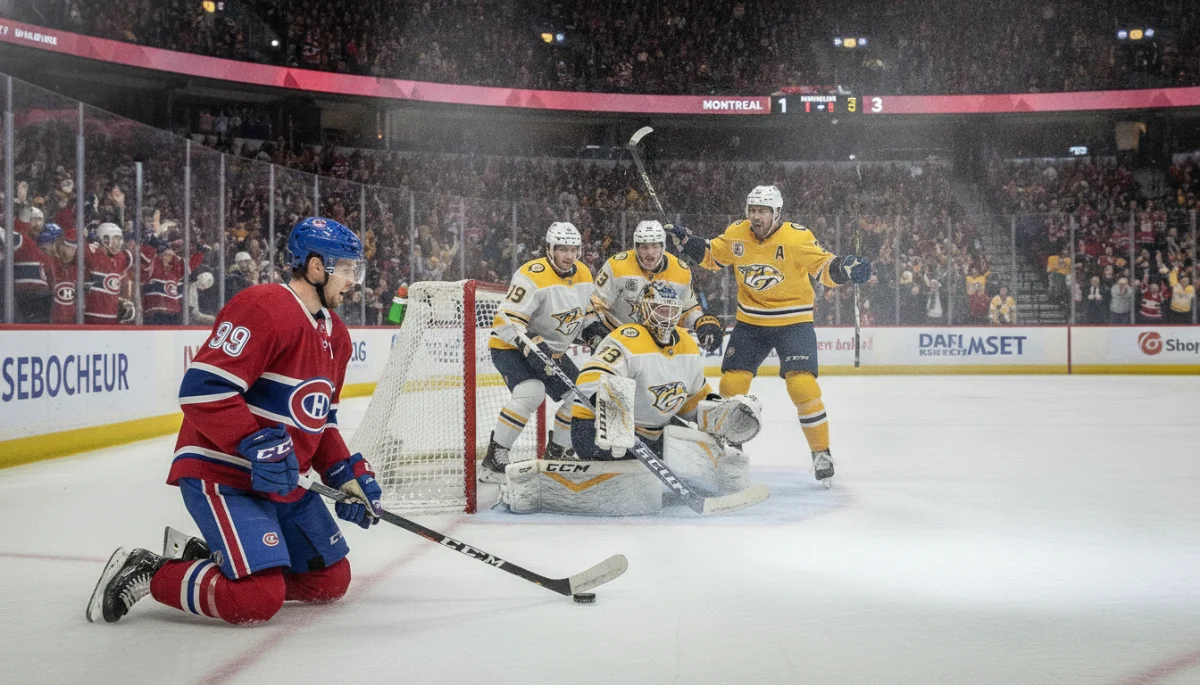
The Montreal Canadiens had nearly everything going their way Thursday night—home ice, territorial control, a two-goal cushion and a frustrated Nashville Predators team struggling to create sustained offense. By the end of the evening, however, Montreal was left trying to explain a five-goal collapse.
Nashville erased a 2-0 deficit with five consecutive goals and finished with a 5-2 victory at the Bell Centre. Ryan O’Reilly’s late power-play deflection supplied the winning goal, while two empty-net scores made the final margin look more decisive than the game itself.
The defeat pushed Montreal’s early-season record to 1-2-1 and extended its winless run to three games. More troubling than the record was the way the loss developed: the Canadiens created enough pressure to win, but they did not finish their chances, surrendered momentum at critical moments and allowed special teams to decide the outcome.
Montreal Built the Kind of Lead It Needed
For much of the first half of the contest, Montreal looked like the more organized and dangerous team. The Canadiens spent extended shifts in the offensive zone, recovered loose pucks quickly and forced Nashville to defend rather than attack.
The opening goal arrived during four-on-four play. Nick Suzuki located a loose puck near the Predators’ crease and quickly converted the opportunity against Juuse Saros. The captain’s willingness to attack the crowded area around the net gave Montreal the breakthrough it had been seeking.
Alex Newhook added another goal midway through the second period. Josh Anderson created the play with a productive offensive shift, and Newhook finished the feed to give the Canadiens a 2-0 advantage.
At that stage, the game appeared to be following Montreal’s script. The crowd at the Bell Centre was engaged, Nashville was having trouble generating clean entries and the Canadiens were controlling both the pace and the location of play.
Yet the two-goal lead never became a three- or four-goal cushion. That omission allowed Nashville to remain within reach, even while Montreal appeared to be dictating the action.
Missed Chances Kept Nashville Alive
The Canadiens’ strongest stretches produced pressure, but pressure alone did not create enough separation. Montreal needed to turn its possession advantage into additional goals before Nashville found a way back into the game.
Juuse Saros was a major reason that never happened. The Nashville goaltender stopped 32 of Montreal’s 34 shots and repeatedly prevented the Canadiens from converting promising sequences into a decisive lead. Saves that seemed routine in isolation became increasingly important as the game tightened.
Montreal’s inability to finish became more damaging after Alexander Kerfoot scored with 4:54 left in the second period. Kerfoot redirected a shot from the point past Jacob Fowler, cutting the Canadiens’ lead to 2-1.
That goal changed Nashville’s energy. The Predators no longer needed to chase a game that seemed to be slipping away; they only needed one more successful sequence to draw even.
They got it with 32 seconds remaining in the period. Matthew Wood scored on the power play, sending the teams into the intermission tied 2-2. Montreal had gone from controlling the contest to entering the third period without any advantage on the scoreboard.
The timing made the goal especially damaging. A team that gives up a tying goal just before intermission has little time to regain its rhythm, while the opponent receives an emotional lift heading into the break. Nashville carried that confidence into the final period.
Special Teams Turned a Close Game Against Montreal
Penalties were central to the Predators’ comeback. Nashville’s tying goal came with a man advantage, and another Montreal infraction later gave the visitors the opportunity to claim their first lead.
Late in the third period, Mike Matheson was penalized for tripping Steven Stamkos. The call placed Montreal in a dangerous situation at precisely the wrong time: the score was tied, the game was nearing its conclusion and Nashville had already shown that its power play could punish mistakes.
With 3:16 left, Roman Josi sent a shot toward the net, and Ryan O’Reilly redirected it past Fowler. The goal put Nashville ahead 3-2 for the first time all night.
Montreal’s power play, meanwhile, did not provide a comparable response. In a game where the margin was extremely narrow, the Predators converted the opportunities that mattered while the Canadiens failed to find the same impact with the extra attacker.
That difference often decides NHL games. A club can play well at five-on-five, but untimely penalties and an unproductive power play can erase much of that work. Montreal learned that lesson in especially frustrating fashion because it had controlled so many minutes before the special-teams battle shifted toward Nashville.
Saros’ Biggest Save Came at a Crucial Moment
Before O’Reilly’s goal, Montreal had a chance to reclaim the lead. With roughly eight minutes left in regulation, Josh Anderson broke in alone against Saros.
The opportunity was exactly the type that can reverse a close game. If Anderson had scored, Montreal would have moved ahead 3-2 and forced Nashville to respond under pressure. Instead, Saros stayed with the play and made the save with his left pad.
That stop became one of the defining moments of the night. Nashville survived a dangerous chance, remained level and soon received the power play that produced O’Reilly’s winner.
The sequence illustrated the difference between the teams. Montreal generated opportunities but did not complete enough of them. Nashville endured its difficult stretches and capitalized when its most important chances arrived.
For the Canadiens, the issue was not a lack of attacking activity. The problem was that the best opportunities did not become goals, allowing one save, one penalty or one bounce to carry far greater weight than it should have.
Fowler’s First Start Deserves Context
Jacob Fowler made his first NHL start of the season after Montreal recalled him from the Laval Rocket. Samuel Montembeault had suffered a lower-body injury during Wednesday’s practice, forcing the Canadiens to adjust their goaltending plans on short notice.
Fowler stopped 15 shots in the loss. The 5-2 final score looks harsh, but two of Nashville’s goals came into an empty net after Montreal pulled its goaltender late in the game. Fowler therefore allowed three goals while actually playing in the crease.
His circumstances were also difficult. Nashville scored twice on the power play, and the winning goal came during a late man advantage created by a Montreal penalty. Those situations made Fowler’s task more demanding than the raw result suggests.
That does not mean every part of his performance was perfect. A young goaltender making a start without much preparation will naturally have moments he would like to improve. Still, assigning the entire defeat to Fowler would ignore the larger problems that shaped the game.
Montreal’s offensive failures, defensive penalties and inability to protect its lead had a greater influence on the result. Fowler needed more support from the players in front of him, particularly once Nashville began building momentum.
Montreal’s Goaltending Picture Is Suddenly Unsettled
The immediate concern is not simply how Fowler played Thursday. It is how long Montembeault may be unavailable and whether Fowler will now be asked to carry a significant workload.
Montreal had not received a clear timetable for Montembeault’s return as of Thursday. That uncertainty places additional attention on Fowler, who already has NHL experience but was not originally expected to assume an important role this early in the season.
Last season, Fowler appeared in 17 games and recorded a 9-6-2 record, a 2.43 goals-against average and a .908 save percentage. Those numbers show that he is not entirely untested at the professional level.
Even so, the Canadiens must make his assignment more manageable if Montembeault misses more time. Cleaner defensive coverage, fewer penalties and better control of rebounds would help Fowler settle into games instead of repeatedly facing high-pressure situations.
Goaltending cannot be evaluated separately from team play. A netminder may stop the first shot, but the players in front of him determine how much traffic develops, whether second chances are available and how frequently the opposition receives power plays.
The Final Margin Hides a Competitive Performance
Montreal should not treat the 5-2 score as proof that it was thoroughly outplayed. Adam Edstrom’s two empty-net goals arrived in the closing minutes and transformed a one-goal game into a three-goal defeat.
At five-on-five, the Canadiens were competitive and controlled significant portions of the contest. The loss came from execution rather than complete domination by Nashville.
That distinction does not make the result less disappointing. In some ways, it makes the defeat more frustrating because Montreal had already done much of the difficult work. The Canadiens established offensive-zone pressure, scored twice and limited Nashville’s early chances, but they did not close the game.
A club trying to take a step forward must learn to recognize when an opponent is vulnerable. Montreal had Nashville under pressure at 2-0, yet the Canadiens did not deliver the additional goal that could have ended the Predators’ comeback before it began.
They also needed greater discipline. The late Matheson penalty did not create the entire defeat, but it gave Nashville a direct path to the lead. Against a team with an effective power play, those opportunities become especially costly.
Suzuki Remains a Bright Spot
Nick Suzuki provided one of the night’s clearest positives. His goal gave Montreal an early lead and marked his third goal of the young season.
The play reflected the kind of offense the Canadiens need from their captain. Suzuki recognized the loose puck, attacked the area near the crease and finished quickly before Nashville could reset.
His role becomes even more important while injuries and lineup uncertainty affect the team. Montreal needs Suzuki to remain involved not only as a scorer but also as a player who can establish offensive-zone possession and create opportunities for teammates.
The Canadiens will look to him again when the Detroit Red Wings visit the Bell Centre on Saturday. A strong response will require more than one player, but Suzuki’s leadership and production will be central to Montreal’s attempt to end its winless stretch.
Detroit Provides an Immediate Test
Montreal has little time to dwell on the collapse. Saturday’s matchup with Detroit offers an immediate chance to correct the habits that undermined Thursday’s performance.
The first priority is finishing. If the Canadiens control the puck and create repeated chances, they must convert often enough to make their territorial advantage meaningful. A 2-0 lead can disappear quickly in the modern NHL, so relying on one or two goals is rarely sufficient.
The second priority is discipline. Nashville’s tying and winning goals both came on the power play, making Montreal’s penalty management a direct factor in the defeat. The Canadiens cannot give Detroit similar opportunities late in a close game.
The third priority is supporting the goaltender. Whether Fowler starts again or Montreal turns to another option, the team must reduce the number of difficult situations in front of the net. Better coverage, fewer rebounds and stronger penalty-killing work would give the goaltender a better chance to succeed.
Montreal also needs a more efficient power play. The unit does not have to dominate every night, but close games often turn on one extra-man goal. Nashville found that goal twice; Montreal did not find one when it needed it.
The Canadiens Need a Response, Not Panic
A 1-2-1 start and three straight games without a win are not enough to define Montreal’s season. The schedule is still young, and the team’s performance against Nashville showed that it can control stretches against a capable opponent.
However, Thursday exposed a gap between playing well and finishing effectively. Montreal led 2-0, generated more pressure for long periods and had a breakaway chance to regain the advantage. It still left the ice without a point.
The next step is learning how to preserve the benefits of strong play. The Canadiens need to score while momentum is on their side, avoid penalties that revive the opposition and remain composed when a game becomes tight.
Nashville did not simply overwhelm Montreal from the opening faceoff. The Predators waited for openings, received outstanding goaltending from Saros and made their power-play chances count. Montreal’s challenge is to show that it can do the same when opportunities appear.
Saturday’s meeting with Detroit will reveal whether the Canadiens can turn the frustration of this collapse into a more complete performance. The talent and effort were visible Thursday. The missing ingredient was the ability to finish the job.