
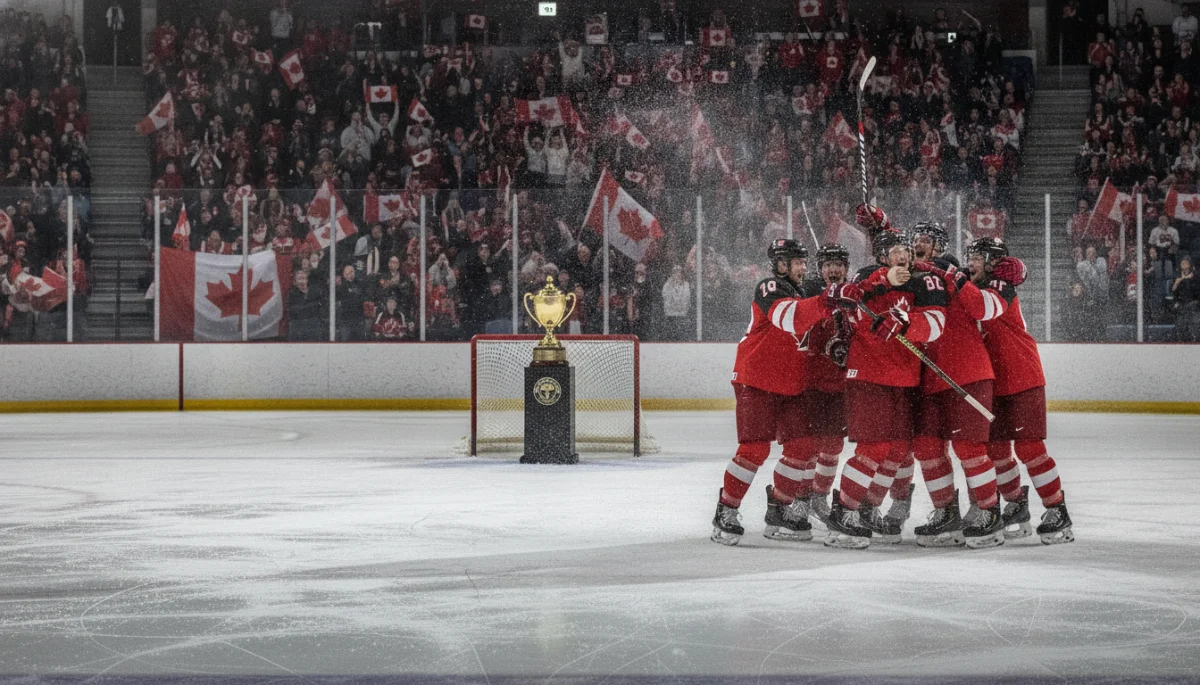
Canada is one win away from the 2026 Hlinka Gretzky Cup final after rolling through the preliminary round in Edmonton. The host team now turns to Finland in Friday’s semifinal at Rogers Place, with a chance to keep its title chase alive.
Canada has looked sharp from the start, winning all three group games and scoring 20 goals along the way. That kind of offensive output has made the Canadians one of the tournament’s clear favorites heading into the knockout stage.
Semifinal Details
Canada and Finland meet on Friday, August 7, 2026, in Edmonton. The semifinal starts at:
- 5 p.m. Mountain Time
- 7 p.m. Eastern Time
- 4 p.m. Pacific Time
- 8 p.m. Atlantic Time
- 8:30 p.m. Newfoundland Time
The winner moves on to Saturday’s gold medal game, while the loser heads to the bronze medal matchup. The semifinal will be played at Rogers Place, where Canada has already built strong momentum in front of its home crowd.
What Canada Has Done So Far
Canada opened with a 7-3 win over Switzerland, using a fast start and balanced scoring to set the tone. Liam Pue and Brock England each scored twice in that game.
The Canadians then beat Slovakia 6-1, with Kayden Stroeder scoring two goals. That result clinched first place in Group A and showed how difficult Canada is to handle when its top lines get rolling.
Canada finished the preliminary round with a 7-4 win over Sweden. The hosts jumped out to a 5-0 lead, fired 49 shots, and held off a Swedish push late in the game.
- Three wins in three games
- 20 goals scored
- Eight goals allowed
- First place in Group A
That record sent Canada into the semifinal against Finland, which placed second in Group B.
Who Canada Could Face If It Advances
If Canada gets past Finland, it will meet either the United States or Slovakia in the final. The Americans and Slovaks face each other in the other semifinal on Friday.
A Canada-U.S. final would be the most high-profile matchup possible. Both teams went unbeaten in preliminary play, and the United States also arrives as the defending champion after winning the 2025 tournament.
A final against Slovakia would create a rematch from the group stage. Canada beat Slovakia 6-1 earlier in the tournament, but Slovakia still has one of the event’s top scorers in Tomas Selic, who led all players with eight points after the preliminary round.
Matchup Notes Against Finland
Finland reached the semifinals by winning two of its three group games. It opened with a comeback victory over Germany, dropped a game against the United States, then edged Czechia 5-4 to secure its spot in the final four.
Finnish goaltender Samu Heikkinen is a major reason the team is still alive. He stopped 38 shots against Czechia and posted a .922 save percentage through the preliminary round.
Canada should spend more time with the puck and generate more chances, but Finland has shown it can stay organized and difficult to break down. If Heikkinen settles in early, Canada may need patience rather than quick strikes.
- Win puck battles in the neutral zone
- Create traffic in front of the net
- Avoid unnecessary penalties
- Stay calm if the first chances do not go in
Finland is comfortable waiting for mistakes, so Canada’s transitions will matter. Turnovers could give the Finns the kind of quick looks they need to make the game tight.
Players Canada Will Lean On
Maddox Schultz has been Canada’s top point producer so far, finishing the preliminary round with one goal and six assists. His seven points put him near the top of the tournament scoring race.
Liam Pue leads Canada in goals with four. He scored twice against Switzerland and added another against Sweden, giving Canada a dangerous finisher around the net.
Kayden Stroeder has been one of the most reliable forwards on the roster. He collected three goals and three assists in the group stage and showed he can produce in different game situations.
Landon DuPont has also drawn attention. The Everett Silvertips defenseman recorded one goal and two assists while helping drive play from the blue line. He also brings experience from last year’s bronze-medal team.
Leif Oaten could matter if the semifinal turns into a lower-scoring game. He posted a 2.50 goals-against average in the preliminary round, and Canada may need him to make key stops if Finland gets chances on the counterattack.
Why Canada Looks Hard to Stop
Canada’s biggest edge is its depth. Four players finished the preliminary round among the tournament’s top seven scorers: Maddox Schultz with seven points, Liam Pue with six, Kayden Stroeder with six, and Ryerson Edgar with five.
The scoring has not come from one line alone. Canada also received offense from defensemen such as DuPont, Jaakko Wycisk, Brock Cripps, and Alexis Joseph. That kind of spread makes it harder for opponents to key on one unit.
For Finland, the challenge is not stopping one player. It is surviving three periods against a roster that can score from multiple spots and keep pressure on at even strength and on the power play.
What Canada Must Clean Up
Canada will need better discipline than it showed late against Sweden. After building a big lead, the team allowed Sweden back into the game with penalties and gave up two power-play goals.
That kind of lapse can be costly in a semifinal. Canada also has to avoid giving Finland easy transition chances, especially through the neutral zone.
On offense, the Canadians should focus on second chances rather than only trying to beat Heikkinen from distance. Screens, rebounds, and net-front pressure should create the best scoring opportunities.
Canada already has the offense to win this tournament. Friday will be about keeping the same pace, staying composed, and finishing the job.