
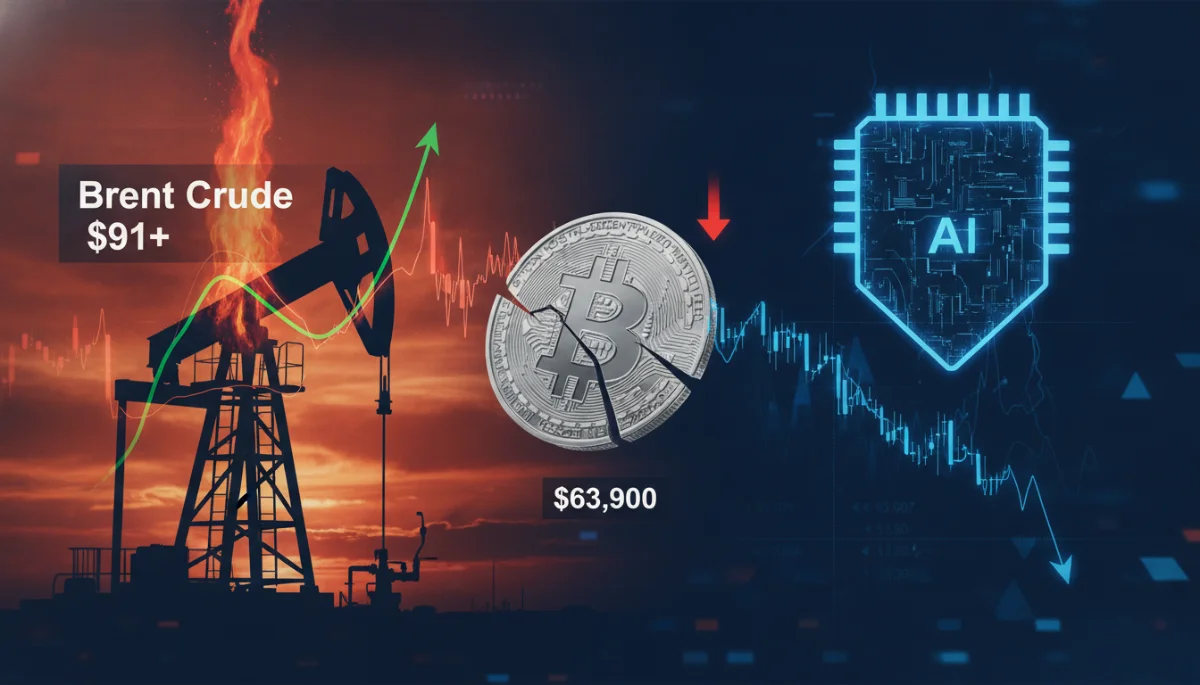
Conflicting Macro Forces Drive Bitcoin’s Sharp Decline
Bitcoin has slipped beneath the critical $64,000 threshold on July 20, 2026, succumbing to a volatile combination of rising energy costs and a broader technology sector downturn. The cryptocurrency traded near $63,900, marking a 1.3% decline over the last 24 hours, as investors reacted to escalating geopolitical tensions between the United States and Iran . These diplomatic conflicts have triggered a surge in Brent crude oil prices, which climbed past $91 per barrel, reigniting fears of persistent inflation despite recent data showing softer U.S. price levels . Historically, such energy price spikes compel investors to anticipate tighter monetary policy from the Federal Reserve, leading them to flee speculative assets like cryptocurrencies in favor of safer holdings. The pressure on digital assets is not limited to energy markets; the technology sector is simultaneously grappling with a significant selloff driven by disappointing earnings from artificial intelligence (AI) chip manufacturers, particularly in Asia . South Korea’s Kospi index plummeted 3.5%, signaling a loss of confidence in AI growth prospects that has spilled over into the crypto market due to its perceived linkage with technology innovation . Shaurya Malwa, a Crypto Market Analyst at Bullish Inc., observed that Bitcoin’s dip reflects a difficult tug-of-war where inflation anxieties fueled by oil prices clash with uncertainties in the tech sector regarding AI advancements . This balancing act has forced portfolio managers to adopt a cautious stance, reducing exposure to riskier assets until macroeconomic clarity emerges. Ethereum also faced downward pressure, softening by 1.1% to trade at $1,850, while other major tokens like Binance Coin (BNB) and XRP experienced modest declines of 0.8% and fluctuating values respectively . Hyperliquid’s HYPE token emerged as a notable underperformer, suffering an 8% weekly loss, which highlights the specific volatility affecting certain sectors within the broader digital asset ecosystem . The market dynamics suggest that without a resolution to geopolitical tensions or a stabilization in AI-related stock performance, Bitcoin may struggle to reclaim the $64,500 resistance zone in the immediate term .
Geopolitical Risks and Technology Sector Weaknesses
The immediate catalyst for Bitcoin’s retreat stems from the intensifying military actions reported between the U.S. and Iran, which have directly impacted global energy supply chains and investor sentiment . Reports of intensified strikes, including a tragic incident where two U.S. troops were killed in Jordan, have amplified market fears and triggered a 5.7% price drop for Bitcoin, breaking the critical support level of $63,000 . Economist Dr. Linda Chen from the Global Economic Forum noted that inflationary concerns arising from such geopolitical conflicts typically prompt a shift away from riskier assets, driving price corrections across the cryptocurrency market . When oil prices rise, the resulting inflationary pressure often leads to higher interest rate expectations, which disproportionately hurt assets that do not yield cash flow, such as Bitcoin. Simultaneously, the AI sector selloff has created a secondary headwind for the cryptocurrency market. The downturn originated with poor performance reports from major AI chip companies in Asia, causing a sharp contraction in indices like the Kospi and reinforcing a negative sentiment toward technology-linked investments . As Shaurya Malwa explained, this chip selloff represents a sector rotation and risk recalibration that indirectly affects crypto, as investors reassess their exposure to technology innovation across the board, including blockchain and crypto assets . The perception that cryptocurrencies are part of the broader technology innovation narrative means that weakness in AI stocks often translates to weakness in digital tokens, exacerbating the downward pressure on prices. Despite the turbulence, Bitcoin exchange-traded funds (ETFs) have recorded small inflows recently, suggesting that some investors view the lower price levels as a buying opportunity . However, CoinDesk Research described these inflows as “peanuts” relative to the recent exodus, indicating that investor confidence remains fragile amid ongoing macroeconomic uncertainties . The modest nature of these inflows suggests that while there is tentative buying, there is not yet a full turnaround in market sentiment. Analysts expect market uncertainty to persist until clear signals emerge regarding inflation trends and the stability of the technology sector, with price trajectories likely to remain volatile in the near term . Investors are advised to monitor geopolitical developments and inflation data closely, as these factors will likely dictate the next major move in crypto market trajectories.