
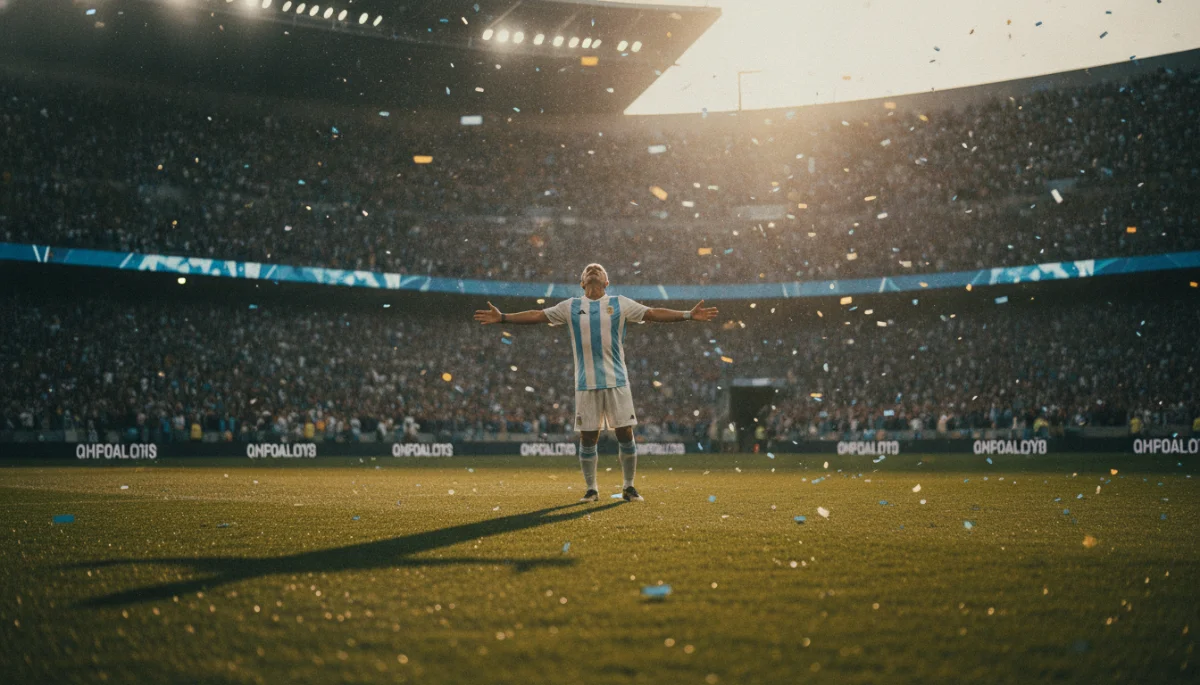
In the rare moments when athletic performance transcends mere statistics and becomes pure artistry, history bends to witness it. That transformation occurred last Monday in Arlington, Texas, as Lionel Messi, now 38 years old, delivered a performance that silenced the world and redefined the very limits of longevity in soccer. With a perfectly curled left-foot finish in the 38th minute against Austria, followed by a gritty, determined rebound goal deep in stoppage time, Messi climbed to the summit of World Cup scoring history. He is no longer just the highest goal scorer among men; he is the undisputed all-time leader for every player, male or female, with a staggering total of 18 tournament goals. This achievement propelled him past Germany’s legendary Miroslav Klose, Brazil’s iconic Marta, and into a realm no athlete has ever occupied before.
The record-breaking surge began earlier than most anticipated, even before Canadian fans fully settled into their World Cup viewing habits. In Argentina’s opening match against Algeria on June 16, Messi produced his first-ever World Cup hat-trick, a historic feat that instantly tied Klose’s long-standing record of 16 goals. At 38 years and 357 days, Messi became the oldest player to score a hat-trick in World Cup history, eclipsing Cristiano Ronaldo, who was 33 when he scored three against Spain in 2018. Six days later, during the clash with Austria, Messi entered the match with 16 goals but missed a penalty in the ninth minute, a moment that briefly denied him the outright record. Yet, that miss only heightened the drama of what followed. He curled home from a cutback in the 38th minute and added a late second goal in the 2-0 victory, pushing his all-time total to 18. Five goals in two games, eighteen across six World Cups: the record is definitively his.
To fully grasp the magnitude of Messi’s achievement, one must consider the two-decade career that led to this pinnacle. Messi scored his first World Cup goal on June 16, 2006, at just 18 years old, against Serbia and Montenegro. Twenty years later, he continues to shatter records, becoming the first player to appear in six different editions of a men’s World Cup. He is also the second man in history to score four or more goals in three separate tournament editions, following Klose’s triumphs in 2002, 2006, and 2010. Remarkably, Messi has joined Roger Milla as the only men to score four or more goals in a single World Cup while aged 38 or older. His teammates, overwhelmed by his performance, have found little to say. “If anyone thought this group was better off without Leo,” said midfielder Alexis Mac Allister after the Austria win, “today it became clear that Leo is the most important of them all.”
| Player | World Cup Goals | Age at Record | Tournaments |
|---|---|---|---|
| Lionel Messi | 18 | 38 | 6 |
| Miroslav Klose | 16 | 35 | 4 |
| Marta | 15 | 34 | 5 |
| Kylian Mbappé | 16 | 25 | 3 |
The record, however, may not remain secure for long. Kylian Mbappé currently holds 16 career World Cup goals, sitting in second place behind only Messi’s 18. The French captain is still deeply involved in this tournament, and with France emerging as genuine contenders, the gap could narrow rapidly. Yet for now, Messi reigns supreme, leaving fans to wonder how many more goals he can add before his final World Cup concludes. Beyond the spectacle, there is a practical reason for global soccer fans, particularly Canadians, to closely monitor Messi’s form: Argentina stands as a potential opponent deep in the tournament. The defending world champions have won all their group matches, conceded zero goals, and appear to be the team to beat. If Canada navigates through the round of 32 and beyond, Messi and Argentina could be waiting. Understanding what they face—a 38-year-old playing the soccer of his life, surrounded by a squad of world-class talent—is not merely interesting; it is essential. Watch tonight’s Argentina vs. Jordan at 10 p.m. ET on TSN. Messi will almost certainly be on the pitch, and if recent form holds, history may be made again.