
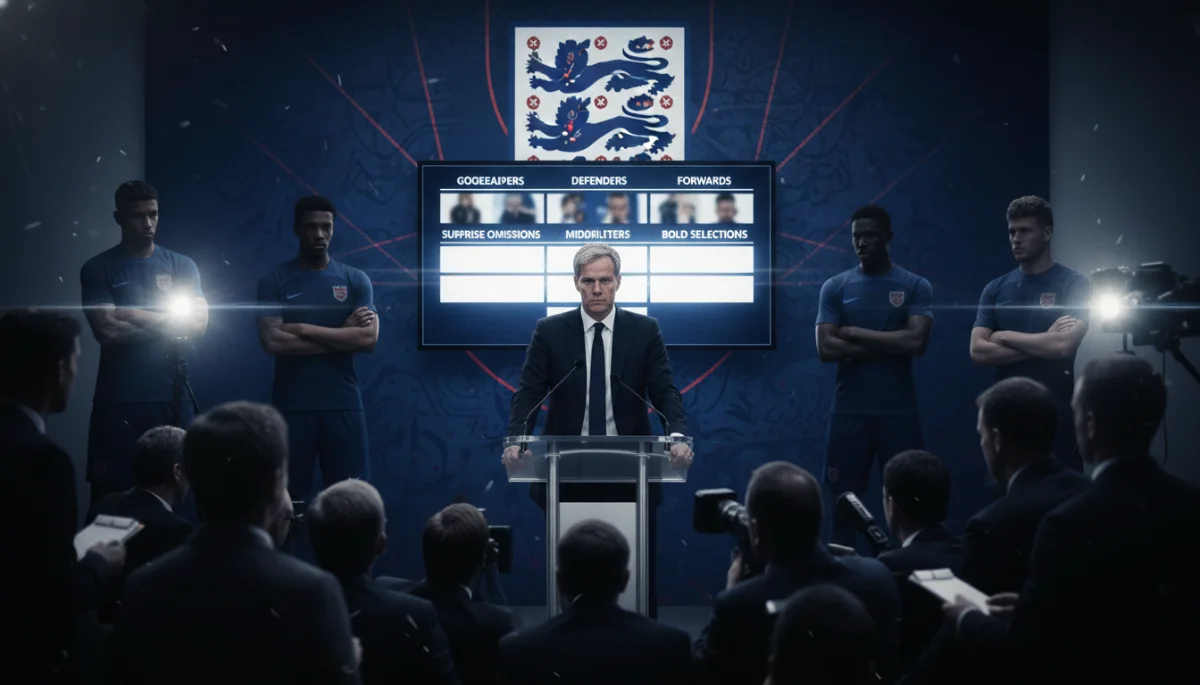
Thomas Tuchel has made a bold first tournament statement, leaving several established England names out of his 26-man World Cup squad for North America. The choices immediately sparked debate because they were not cautious, and they were not designed to please everyone.
Tuchel did not hide behind soft language when the list was announced. He made clear that he welcomed difficult calls, and the final squad showed exactly that mindset. For some players, the news was a surprise. For others, it was a harsh reminder that reputation alone would not secure a seat on the plane.
Major omissions set the tone
The biggest talking points are the absences of Cole Palmer, Phil Foden, Trent Alexander-Arnold, and Harry Maguire. Each of them has been a familiar England figure, and all four would have been near automatic selections in previous cycles. Their exclusion turned this squad release into one of the most discussed England announcements in recent memory.
Palmer and Foden stand out most because of their attacking talent and profile. Yet both had quieter club seasons than expected, and England’s crowded forward areas left little room for sentiment. Tuchel clearly felt he had enough creative quality elsewhere, so the competition for places worked against them.
Alexander-Arnold’s omission was easier to foresee, even if it still carried weight. The Real Madrid defender has not added to his England appearances since last summer, and his absence from recent camps meant he never built enough momentum. Maguire, meanwhile, reacted openly to the decision, saying on social media that he was shocked and disappointed to miss out.
Fresh faces and trusted performers
There were also some selections that created a different kind of buzz. Ivan Toney earned a surprise recall despite now playing his club football for Al-Ahli in Saudi Arabia. His presence gives England a different striker option behind Harry Kane and adds another route into the attack if Tuchel wants variety.
The squad also rewards players who have impressed in recent camps and brought energy into the group. Djed Spence, Kobbie Mainoo, Eberechi Eze, Noni Madueke, Jarell Quansah, and John Stones all made the final cut. That blend of experience and youth suggests Tuchel is trying to protect the chemistry England developed across the autumn internationals while still keeping the squad refreshed.
The overall picture is clear: he values balance more than star power alone. Players who fit specific roles and contributed to a stable team structure were favored over those who might create selection headaches or force awkward tactical compromises.
Why Tuchel stuck with this group
Tuchel said the process was emotionally difficult and that he had spoken directly with every player involved in camp at least once. He also acknowledged that several of those left out had done enough to deserve consideration. In other words, this was not a simple case of poor form being punished across the board.
Instead, the manager leaned heavily on the squad that delivered reliable performances during the September, October, and November windows. That stretch gave England a strong base, and Tuchel appears determined not to disturb it unless there is a clear reason. His thinking was practical: avoid overloading one position, avoid moving players into unfamiliar roles, and avoid carrying unnecessary imbalance into a major tournament.
That approach may not satisfy every observer, but it explains the shape of the final group. England now travel with a squad built on familiarity, positional clarity, and a belief that trust can matter as much as talent when the pressure rises.
The full 26-man squad
Goalkeepers: Jordan Pickford, Dean Henderson, and James Trafford.
Defenders: Reece James, Ezri Konsa, Jarell Quansah, John Stones, Marc Guehi, Dan Burn, Nico O’Reilly, Djed Spence, and Tino Livramento.
Midfielders: Declan Rice, Elliot Anderson, Kobbie Mainoo, Jordan Henderson, Morgan Rogers, Jude Bellingham, and Eberechi Eze.
Forwards: Harry Kane, Ivan Toney, Ollie Watkins, Bukayo Saka, Marcus Rashford, Anthony Gordon, and Noni Madueke.
With the squad now set, the argument has shifted from who missed out to whether this version of England is strong enough to go deep in the tournament. Tuchel has chosen continuity, and he has done so without trying to soften the edges. If the gamble works, it will look decisive. If it fails, the missing names will only make the debate louder.