
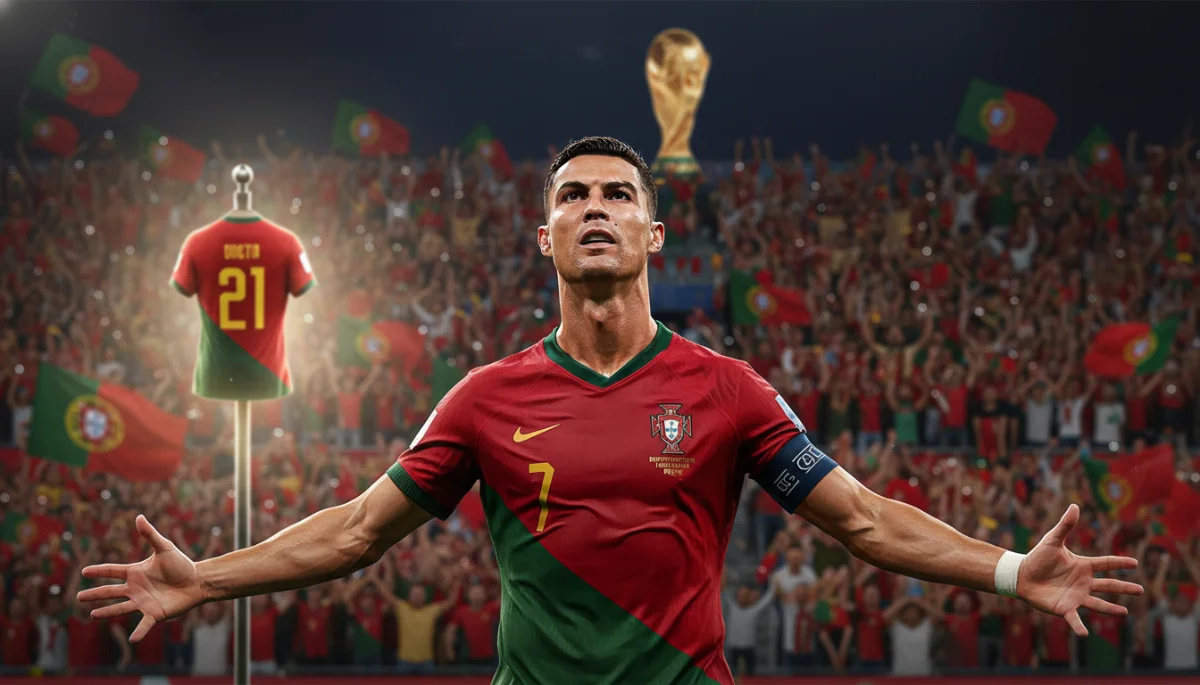
Portugal’s latest World Cup squad announcement carried both ambition and emotion. On one side, there is Cristiano Ronaldo, still pushing toward another historic milestone as he prepares for what could be his sixth World Cup appearance. On the other, there is the lasting presence of Diogo Jota, whose memory has become part of the team’s identity as the tournament approaches.
Roberto Martínez has assembled a squad that mixes senior leadership with technical quality and real depth across the field. That balance gives Portugal a legitimate chance to challenge the best nations in the competition, even if the team has never lifted the trophy before.
Ronaldo’s Record Chase Still Defines the Conversation
Cristiano Ronaldo remains the central figure in every major Portugal announcement, and this squad is no exception. At 41, he is still being selected for more than sentiment. Martínez is clearly valuing the forward’s experience, competitive edge, and influence on the rest of the group.
If Ronaldo takes the field at the tournament, he will join a tiny group of men to play in six different World Cups. That alone would add another remarkable chapter to a career already filled with milestones. His long rivalry with Lionel Messi could also reach a similar landmark if the Argentina captain features as expected.
Ronaldo’s international résumé already includes some of the most notable records in the sport:
- He is the highest scorer in men’s international football.
- He has made more appearances for a men’s national team than anyone else.
- He is the only male player to score in five separate World Cups.
- He remains the most recognizable figure in modern Portuguese football.
For Portugal, the point is not just whether Ronaldo can still deliver goals. It is also about what he brings in pressure moments, how he raises standards in training, and how his presence changes the way opponents prepare.
The Emotional Center of the Squad Is Diogo Jota
While Ronaldo drew the loudest attention, the most moving part of the announcement was the tribute to Diogo Jota. The former Liverpool and Portugal forward died in a car crash in Spain last year at the age of 28, a loss that sent shock through the football world.
Martínez made it clear that Jota will remain part of the team’s story. Portugal’s symbolic use of a 27th name, despite the official World Cup limit of 26 players, was a powerful gesture. Jota is being remembered as the squad’s permanent “plus one,” a way of carrying his spirit into the competition.
That kind of tribute is more than symbolic. It gives the squad a shared emotional purpose. Players often talk about finding extra motivation in major tournaments, and in Portugal’s case that motivation is deeply personal.
A Squad Built for Balance, Not Just Fame
Portugal’s group is impressive because it is not built around one style or one line of the pitch. It offers a blend of calm distribution, aggressive fullback play, creative midfielders, and forward options that can hurt teams in several ways.
There is real flexibility here. Martínez can shape the attack around Ronaldo, use a more mobile center forward, or stretch defenses with pace out wide. That variety is important in a tournament setting, where games often demand different solutions from one match to the next.
A few broad strengths stand out:
- Strong goalkeeping depth and reliable competition for the starting role.
- Center backs who can defend physically and move the ball with confidence.
- Midfielders who can control possession and also create chances quickly.
- Attackers who combine finishing, dribbling, movement, and width.
Defensive and Midfield Core
In goal, Portugal can turn to Diogo Costa, José Sá, Rui Silva, and Ricardo Velho. Costa is the standout name, but the overall group gives the coaching staff cover and options heading into a demanding tournament schedule.
At the back, Rúben Dias will likely remain the anchor. He is joined by players such as João Cancelo, Diogo Dalot, Nuno Mendes, Nélson Semedo, Gonçalo Inácio, Renato Veiga, Tomás Araújo, and Matheus Nunes, giving Portugal a defense that can handle both traditional pressure and modern buildup demands.
The midfield looks especially strong. Bruno Fernandes and Bernardo Silva bring vision and experience, while Vitinha, João Neves, Rúben Neves, and Samú Costa add control, energy, and tactical flexibility. That blend could be crucial in matches where Portugal needs to dominate the ball or recover quickly after turnovers.
Attack Options That Can Change a Match Fast
Portugal’s front line may be the area that draws the most excitement. Ronaldo gives the team a reliable finisher, but the rest of the group adds pace and unpredictability.
- Cristiano Ronaldo
- Rafael Leão
- João Félix
- Gonçalo Ramos
- Pedro Neto
- Francisco Conceição
- Gonçalo Guedes
- Francisco Trincão
That selection gives Portugal several ways to attack. Leão and Neto can stretch the field, Conceição can break lines with direct dribbling, Félix can link play between the midfield and final third, and Ramos offers a more natural center-forward profile if Ronaldo is used differently.
Group Stage Path and Preparation Plans
Portugal was placed in Group K and will face Congo, Uzbekistan, and Colombia. It is a group that should test organization and consistency rather than simply reputation.
The schedule begins with a June 17 opener against Congo in Houston. Before that, the squad is due to gather on June 1, which gives Martínez a short but important window to settle routines and sharpen combinations.
The buildup includes two key friendlies and travel across the Atlantic:
- Portugal vs. Chile on June 6
- Portugal vs. Nigeria on June 10
- Travel to the United States on June 12
- Portugal vs. Congo on June 17
Those warm-up matches should help Martínez answer a few major questions: Which midfield pairing is most stable? Who starts on the wings? How much direct responsibility should Ronaldo carry? By the time the group stage starts, Portugal should know far more about its best shape.
Why Supporters Believe This Team Can Go Deep
Martínez has tried to keep expectations measured, but Portugal’s recent results make optimism reasonable. The team won the 2025 Nations League after beating Germany in the semifinal and Spain in the final, which is a strong sign that this squad can handle top-level pressure.
Portugal still has not won a World Cup, and that remains the main missing piece in the national team’s modern history. But this group has several ingredients that make a serious run believable.
Those ingredients include:
- Experience from senior players who have been in major knockout matches before.
- Creative quality in midfield that can unlock compact defenses.
- Fast, dangerous attackers capable of punishing mistakes.
- A defense led by one of the world’s best center backs.
- Emotional drive from the tribute to Jota and the desire to honor him properly.
If Portugal can keep the right balance between control and aggression, it could become one of the toughest teams to eliminate. That is especially true in tournaments where depth and adaptability often matter as much as pure star power.
A Tournament With History, Pressure, and Meaning
For Ronaldo, this could be the final major World Cup chapter of an extraordinary international career. Winning the trophy would complete a legacy that already includes European Championship glory, a Nations League title, and a long list of individual records.
For Martínez, the challenge is simpler to state and harder to achieve: turn one of Portugal’s most talented generations into world champions. The squad appears strong enough to dream big, but it will still need discipline, resilience, and timely performances.
For the team itself, this is about more than chasing silverware. It is about carrying Jota’s memory with dignity while giving Ronaldo one more chance to create history. Portugal enters the tournament with talent, belief, and a powerful sense of purpose, and that combination can carry a team a long way.