
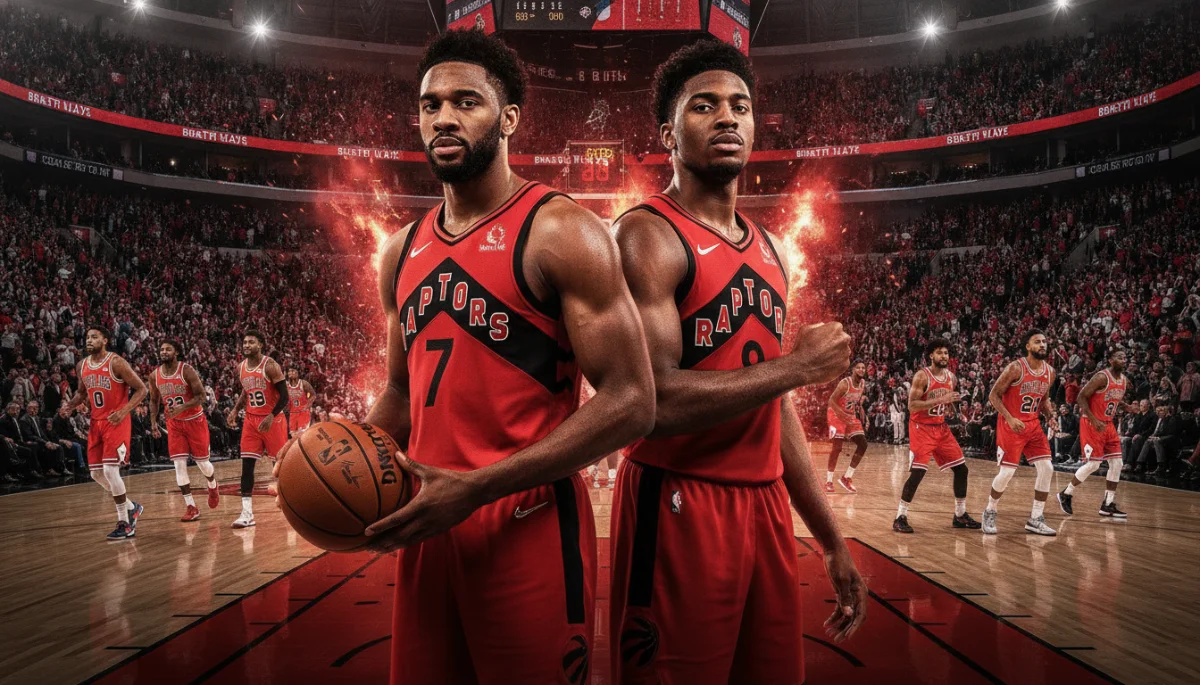
The Toronto Raptors open the 2026–27 NBA season at home against the Chicago Bulls on Wednesday, October 21. Tipoff is scheduled for 7:30 p.m. ET at Scotiabank Arena, where fans will get their first regular-season look at a dramatically reshaped Toronto team.
The spotlight will naturally fall on Kawhi Leonard, whose return reconnects the franchise with its championship past. Yet this game also represents a major opportunity for Scottie Barnes and the Raptors’ younger core to show that Toronto can compete at a higher level in the Eastern Conference.
Chicago enters the matchup with a developing roster and plenty to prove. Toronto, meanwhile, carries greater expectations, making the season opener an early test of whether its experience and defensive talent can translate into immediate success.
Opening-Night Details and the Bigger Story
Toronto and Chicago will meet at Scotiabank Arena in the first game of the new regular season. The Raptors have home-court advantage, but the significance of the night goes beyond the opening result.
Leonard’s second era in Toronto gives the matchup unusual emotional weight. His first stint ended with the organization’s only NBA championship in 2019, and his return has revived memories of the playoff run that made him one of the most celebrated athletes in franchise history.
At the same time, Toronto cannot build its future entirely around nostalgia. The organization needs Leonard to complement its emerging talent, provide dependable two-way play, and help establish a winning standard for a roster that is still taking shape.
Leonard Brings Elite Two-Way Experience
Leonard remains one of the league’s most accomplished players when healthy. At 35, he offers polished footwork, reliable shot creation, strong perimeter defense, and the calm decision-making that becomes especially valuable in close games.
His presence should give Toronto a dependable option when an opponent takes away the first action. Leonard can operate from the midrange, attack mismatches, draw defensive attention, or create a late-clock shot without forcing the rest of the lineup to carry every possession.
His availability will be just as important as his production. Toronto must manage his workload carefully over a long season, while the coaching staff works out how often he should handle primary scoring responsibilities and how frequently he should play alongside the team’s younger stars.
The Bulls could offer an ideal opening challenge. Their young group may attack with energy and unpredictability, but Leonard’s ability to slow the game down could help Toronto control crucial stretches.
Barnes Sets the Direction for Toronto’s Future
Even with Leonard back in the fold, Scottie Barnes remains the player most closely tied to Toronto’s long-term identity. His combination of size, passing, rebounding, defensive versatility, and transition play allows him to influence the game in several ways.
Barnes averaged 18.1 points, 7.5 rebounds, and 5.9 assists last season, numbers that reflect his role as more than a conventional forward. He also earned selection to the NBA All-Defensive Second Team, reinforcing his growing reputation as a player capable of affecting both ends of the floor.
The most intriguing question is how Barnes and Leonard share responsibility. Neither player needs to dominate the ball on every possession. Barnes can initiate offense, attack closeouts, and operate as a secondary playmaker, while Leonard can punish favorable matchups and take control when Toronto needs a reliable scorer.
Their defensive partnership could be even more important. Both players can switch across multiple positions, challenge passing lanes, and make life difficult for opposing wings. If their communication is sharp from the opening tip, Toronto may establish a defensive identity immediately.
Why Chicago Could Make the Opener Difficult
The Bulls are beginning a different kind of project. After missing the playoffs for four straight seasons, Chicago is focused on developing a younger roster rather than relying on an established veteran core.
Josh Giddey, Matas Buzelis, and rookie Caleb Wilson are among the players expected to draw attention. Their roles may evolve throughout the season, but the opener gives them an immediate chance to measure themselves against a Toronto lineup with legitimate postseason ambitions.
Chicago’s best path may involve pace, ball movement, and aggressive attacks before the Raptors can organize their half-court defense. Young teams can create problems when they play freely, especially if their athleticism produces transition opportunities and second-chance possessions.
Toronto should not assume that home-court advantage will settle the contest. New-season games often contain uneven stretches as rotations, spacing, and defensive responsibilities are still being established. A few early turnovers or missed box-outs could allow Chicago to build confidence.
The Matchup Areas That Matter Most
Toronto’s Half-Court Offense
The Raptors need to determine whether Leonard can generate efficient offense without disrupting Barnes’ development. The ideal outcome would feature both stars making quick decisions, with RJ Barrett and Immanuel Quickley providing additional scoring and playmaking around them.
When Toronto’s first option is covered, the next pass will matter. Ball movement can prevent Chicago from loading up against Leonard, while Barnes’ ability to find cutters and shooters may create easier looks than isolation-heavy possessions.
Defensive Pressure on Chicago’s Young Players
Toronto has the personnel to make the Bulls work for every clean possession. Leonard and Barnes can defend primary threats, while the team’s broader athleticism should help it recover after switches and contest shots around the perimeter.
Forcing Chicago into difficult half-court decisions would reduce the value of its speed. Toronto should prioritize transition defense, close out under control, and avoid giving the Bulls simple baskets after live-ball turnovers.
Rebounding and Interior Control
The battle around the rim could decide whether Chicago stays competitive. Jakob Poeltl will be central to Toronto’s efforts to secure defensive rebounds, protect the paint, and create extra possessions through offensive boards.
Barnes also needs to contribute consistently on the glass. If the Raptors finish possessions with rebounds, they can slow Chicago’s tempo and put more pressure on the Bulls to score against a set defense.
Does Toronto Have Contender Potential?
Toronto has a credible foundation for a strong season. The team finished fifth in the Eastern Conference last year with a 46–36 record, and adding Leonard gives the roster another experienced defender and proven playoff scorer.
The supporting cast remains essential. Barrett and Quickley must provide efficient offense, while the younger players need to understand their responsibilities without becoming hesitant around two established stars.
Health, chemistry, and consistency will determine whether the Raptors are merely competitive or genuinely dangerous. A talented starting group is not enough if the rotation cannot maintain defensive intensity or produce reliable offense when Leonard rests.
That makes the Bulls game useful as an early measuring stick. Toronto does not need to reveal its entire identity on opening night, but it should demonstrate disciplined defense, purposeful ball movement, and a clear plan for involving Barnes and Leonard together.
Prediction: Toronto Has the Stronger Starting Position
The Raptors enter as the more complete team. They have home-court advantage, a proven two-way star, a versatile centerpiece in Barnes, and a roster that finished among the Eastern Conference’s better teams last season.
Chicago’s youth could create stretches of excitement, particularly if Giddey pushes the pace and the Bulls make shots from outside. However, Toronto’s defensive flexibility and late-game experience should give it more reliable answers when the contest becomes physical.
The prediction favors Toronto, provided Leonard and Barnes establish a comfortable rhythm and the Raptors avoid careless turnovers. A strong performance from Poeltl on the boards would further improve their chances.
More than the final score, the opening night will reveal whether Toronto’s new direction already has a recognizable shape. Leonard represents the championship standard the franchise once reached, while Barnes embodies the next phase. Their partnership could determine how far this season ultimately goes.